

 GET A QUOTE
How to Choose a Drilling Machine Manufacturer in India for Automated Production
9 October, 2026
Powering Industries with Precision Engineering

29 September, 2026
Drilling is one of the most common and important machining operations in modern manufacturing. From automotive components and engineering parts to aerospace, defence and industrial products, accurate drilling plays an important role in maintaining product quality and production efficiency.
However, when drilling requirements increase, conventional machines may not always provide the speed, consistency or automation required for large-scale production. This is where industrial drilling machines become an important part of a modern manufacturing setup.
For manufacturers, understanding different types of drilling machines, their applications and the benefits they offer can help in selecting the right solution for a particular production requirement.
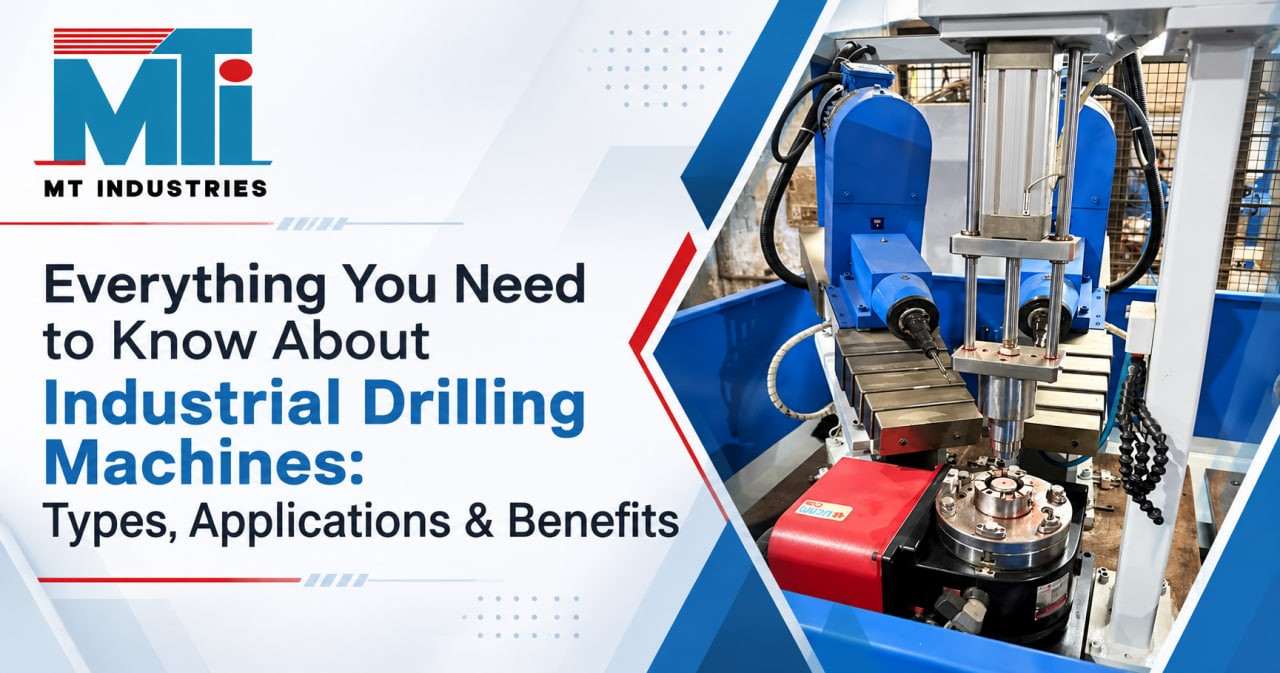
An industrial drilling machine is designed to perform drilling operations on components with a focus on accuracy, repeatability and production efficiency.
Unlike basic drilling equipment used for occasional machining, industrial machines are developed for repetitive production environments where components may need to be processed continuously.
Depending on the application, an industrial drilling system can be configured with different spindle arrangements, fixtures, tooling and automation features.
The machine can be designed around factors such as:
This makes industrial drilling solutions suitable for a wide range of manufacturing applications.
There is no single drilling machine that is suitable for every production requirement. Different industries and components require different machine configurations.
A multi drilling machine is designed to perform multiple drilling operations on a component
Instead of completing every hole separately, multiple drilling operations can be performed within a single production cycle, depending on the component and machine configuration.
This can help reduce handling and improve production throughput, especially in repetitive manufacturing applications.
A multi-spindle drilling machine uses multiple spindles to perform drilling operations simultaneously or in a coordinated sequence.
These machines are particularly useful when a component contains several holes that need to be produced consistently.
The configuration can be customised according to hole position, diameter, depth and production requirements.
Automation can significantly reduce repetitive manual operations.
An automatic drilling machine can be integrated with component loading, clamping, drilling, inspection and unloading systems depending on the application.
This type of setup can help manufacturers achieve a more controlled and repeatable production process.
Certain applications require high-speed drilling for smaller holes or specialised components.
High-speed drilling solutions can be developed according to the required material, hole size, spindle speed and production cycle.
The machine configuration should always be selected based on the actual machining requirement rather than speed alone.
A Special Purpose Machine (SPM) is designed around a specific manufacturing requirement.
Instead of using a general-purpose machine for several separate operations, an SPM can combine selected operations into one customised production solution.
For example, a machine may be designed to perform:
The exact combination depends on the component and production process.
This approach can help reduce unnecessary handling and create a more streamlined manufacturing cycle
The biggest advantage of industrial drilling automation is the ability to create a more consistent and efficient production process.
When multiple operations can be performed within the same cycle, manufacturers can reduce unnecessary movement and handling.
This can be particularly valuable in high-volume production environments.
Repeatability is important when hundreds or thousands of similar components are being produced.
A properly engineered machine can maintain consistent drilling positions and machining operations throughout production.
Automation can reduce repetitive manual tasks such as component positioning, clamping and movement.
This allows operators to focus more on machine supervision, quality checks and production management.
When cycle time, handling and manual intervention are reduced, overall production efficiency can improve.
The actual improvement depends on the component, machine configuration and production process.
Industrial drilling solutions are used across multiple manufacturing sectors.
Automotive components often require multiple accurate holes and repetitive production operations. Automated drilling solutions can help manufacturers maintain consistent machining across large production volumes.
These sectors often require precision components manufactured to demanding specifications. Controlled drilling and inspection processes are important for maintaining dimensional accuracy.
General engineering and component manufacturers can use customised drilling machines for repetitive production requirements involving different materials and component designs
Industrial components may require multiple holes, tapping or other machining operations. A customised machine can combine selected operations to improve production efficiency.
Choosing the right machine starts with understanding the production requirement. Before investing in a drilling solution, manufacturers should evaluate: Component: What material, size and geometry does the component have?
Drilling requirement: How many holes are required, and what are their diameters and depths?
Production volume: How many components need to be produced per shift or month?
Cycle time: What production cycle is required to meet the target output?
Automation: Which operations need to be automated?
Future requirements: Will production volume or component requirements increase in the future?
These details help engineers develop a machine configuration that is suitable for the application.
MT Industries, based in Ghaziabad, Delhi NCR, specialises in Special Purpose Machines and precision engineering solutions. Its manufacturing capabilities include multi-drilling machines, multi-tapping machines, multi-operation machines, rotary drilling solutions and high-speed drilling applications.
The company has been involved in multi-drilling technology in India since 1985 and has developed customised machine solutions for sectors including automotive, defence, aerospace, railways and industrial manufacturing.
Its manufacturing approach focuses on developing machines around specific production requirements rather than relying only on standard machine configurations.
With its base in India, the company serves manufacturing requirements beyond the local market, with its official product information stating that more than 2,500 SPM machines have been delivered across the world.
Every manufacturing process has its own challenges. A standard drilling machine may work well for one component but may not provide the desired efficiency for another.
Customisation allows machine design to consider the complete production process, including tooling, fixtures, spindle configuration, component handling and automation.
The objective is not simply to build a machine that drills holes. It is to develop a production solution that can perform the required operations efficiently and consistently.
Industrial drilling machines have become an important part of modern automated manufacturing. From multi-spindle drilling to high-speed drilling and customised SPM solutions, different machine configurations can address different production requirements.
The right solution depends on the component, production volume, machining requirements, cycle time and desired level of automation.
For manufacturers in India and international markets, working with an experienced engineering manufacturer can help transform a specific production challenge into a customised and efficient machining solution.
When selecting an industrial drilling machine, the focus should ultimately be on accuracy, productivity, repeatability, automation and suitability for the application.