

 GET A QUOTE
How to Evaluate a Special Purpose Machine Manufacturer in India Before Buying
20 September, 2026
Powering Industries with Precision Engineering

21 July, 2026
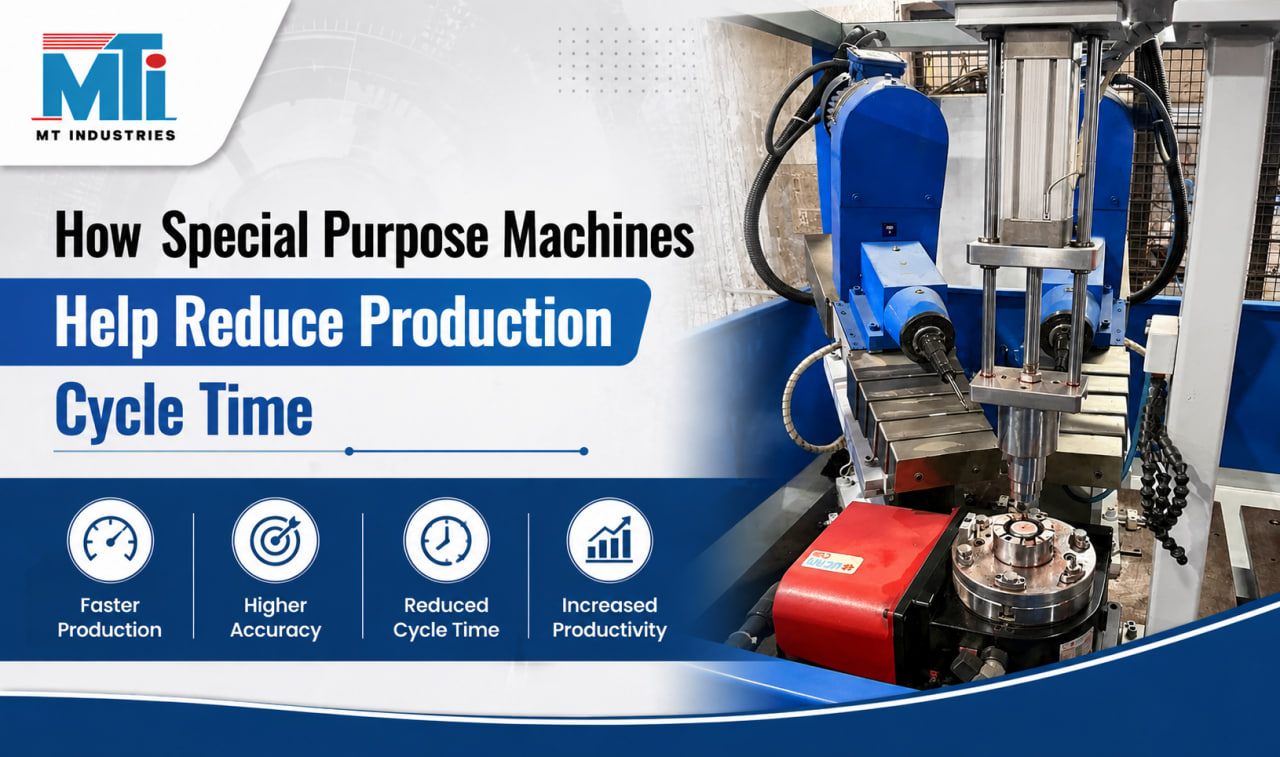
Cycle time is one of those numbers that quietly determines whether a production line is profitable or just busy. Two shops can run the same shift length, use similar labor, and still end up with wildly different output, and more often than not, the difference comes down to how many separate steps a single part has to pass through before it's finished. This is the exact problem a Special Purpose Machine is built to solve, by collapsing multiple operations into a process engineered around one specific component.
This article looks at where cycle time actually gets lost in conventional manufacturing, how purpose-built machines address it directly, and what to evaluate before investing in one for your own production line.
Before looking at the solution, it helps to understand where time disappears in a typical multi-machine setup:
None of these delays show up as "wasted" time on paper — they look like normal parts of the process. But added together across thousands of cycles, they represent a significant chunk of a shift that isn't actually producing finished parts.
A Special Purpose Machine, generally referred to as an SPM, is engineered around one specific component or one defined production sequence, rather than built for general flexibility across many different jobs. Fixtures, tooling, spindle spacing, and control logic are all designed to match the part being produced, which means the machine doesn't need to be reconfigured between cycles the way a general-purpose machine often does.
This focus is exactly what drives cycle time reduction. When a machine is built around one process, there's no time lost figuring out a setup — the setup is the machine.
One of the most direct ways cycle time drops is by combining several operations into a single setup, which is what a Multi Operation SPM Machine is designed to do. Instead of drilling on one machine, tapping on another, and reaming on a third, all three operations happen while the part stays clamped in one fixture.
This matters for cycle time in a very practical way:
Manufacturers who consolidate operations this way commonly report cycle-time reductions in the range of 30-50%, simply from removing the transfer and re-fixturing steps that a multi-machine process requires.
A catalog machine is built to handle a wide range of components reasonably well, but "reasonably well" often isn't good enough when cycle time is the priority. A Custom SPM Machine is designed around the specific dimensions, material, and tolerance requirements of one part, which typically allows for tighter, faster cycles than a general-purpose alternative could achieve.
The practical advantages of a custom-built approach include:
For manufacturers running the same component at high volume, the upfront cost of a custom design is usually recovered quickly through the cycle-time savings compared to adapting a general-purpose machine to the job.
Beyond consolidating operations, the next meaningful reduction in cycle time comes from removing manual steps entirely. Automated SPM Solutions handle loading, clamping, cycle initiation, and often part ejection through programmable sequencing rather than operator action, which keeps cycle timing consistent and removes the pauses that come with manual handling.
This shift typically delivers:
For manufacturers already running a multi-operation SPM, adding automation is often the difference between a good cycle-time improvement and a genuinely competitive one.
Reducing cycle time on a single machine only goes so far if the rest of the line can't keep pace. This is where broader industrial automation, conveyor integration, robotic part handling, PLC-based line coordination, becomes relevant. A fast SPM feeding into a slow manual inspection station or a bottlenecked downstream process doesn't actually improve overall throughput; it just shifts the bottleneck.
Manufacturers getting the most value from SPM investment typically look at automation as a system-level decision, not a single-machine one, synchronizing the SPM's output rate with upstream feeding and downstream handling so gains at one station actually translate into gains across the whole line.
At MT Industries, cycle time reduction starts with mapping the existing process before any machine is designed, identifying exactly where transfer time, re-fixturing, and changeover are eating into output. The engineering team at MT Industries typically builds around that specific bottleneck rather than offering a generic multi-operation machine and expecting it to fit.
This process-first approach at MT Industries generally results in:
Manufacturers who've worked with MT Industries often mention that the biggest cycle-time gains came not from raw machine speed, but from removing steps that weren't actually necessary once the process was redesigned around one component.
A few practical questions help clarify whether an SPM investment will actually deliver measurable cycle-time improvement:
Current bottleneck — Is time being lost primarily in transfer, re-fixturing, changeover, or inspection? Different bottlenecks call for different machine configurations.
Production volume — Does your run length justify a dedicated setup, or would the investment outpace the actual time saved at your current volume?
Line balance — Will a faster SPM actually increase output, or will the gain simply shift the bottleneck downstream?
Changeover frequency — If your product mix changes often, does the SPM's tooling flexibility match that reality, or is it built for one fixed part only?
Answering these honestly before committing to a design prevents the common mistake of solving the wrong bottleneck.
Cycle time reduction isn't really about running machines faster — it's about removing the steps that don't need to exist in the first place. A well-designed Special Purpose Machine does this by consolidating operations, eliminating transfer and re-fixturing time, and, where automation is layered in, removing manual pauses from the cycle entirely. For manufacturers still running components through several separate machines, redesigning that process around a purpose-built setup remains one of the most reliable ways to cut cycle time without sacrificing the accuracy the part actually requires.
1. What is a Special Purpose Machine (SPM)?
A Special Purpose Machine (SPM) is designed for a specific manufacturing process or component, helping improve productivity, accuracy, and production efficiency.
2. How does a Multi Operation SPM Machine reduce cycle time?
It performs multiple operations such as drilling, tapping, and reaming in a single setup, reducing handling time and increasing production speed.
3. Is a Custom SPM Machine suitable for small-scale production?
Custom SPM Machines are best suited for medium- to high-volume production, where improved efficiency and lower cycle times provide a strong return on investment.
4. How do Automated SPM Solutions improve productivity?
Automated SPM Solutions reduce manual intervention by automating loading, clamping, and machining processes, ensuring faster and more consistent production.
5. How is Industrial Automation different from using an SPM?
An SPM automates a specific machining process, while Industrial Automation optimizes the entire production line, including material handling and workflow.
6. Does MT Industries manufacture customized Special Purpose Machines?
Yes. MT Industries designs customized SPMs based on component specifications, production requirements, and application needs.
7. How much cycle time can an SPM reduce?
The exact reduction depends on the application, but SPMs can significantly improve productivity by combining multiple operations into a single machine.
8. What is the difference between an SPM and a CNC machine?
An SPM is built for high-speed production of a specific component, whereas a CNC machine offers greater flexibility for machining a wide variety of parts.
9. Can an SPM be integrated into an existing production line?
Yes. In many cases, an SPM can be integrated into an existing production setup with minimal modifications, depending on production requirements.
10. How do I know if my production line needs a Special Purpose Machine?
If your production involves repetitive operations, high volumes, and long cycle times, a Special Purpose Machine can help improve efficiency and reduce manufacturing costs.