

 GET A QUOTE
How to Evaluate a Special Purpose Machine Manufacturer in India Before Buying
20 September, 2026

Powering Industries with Precision Engineering

21 July, 2026
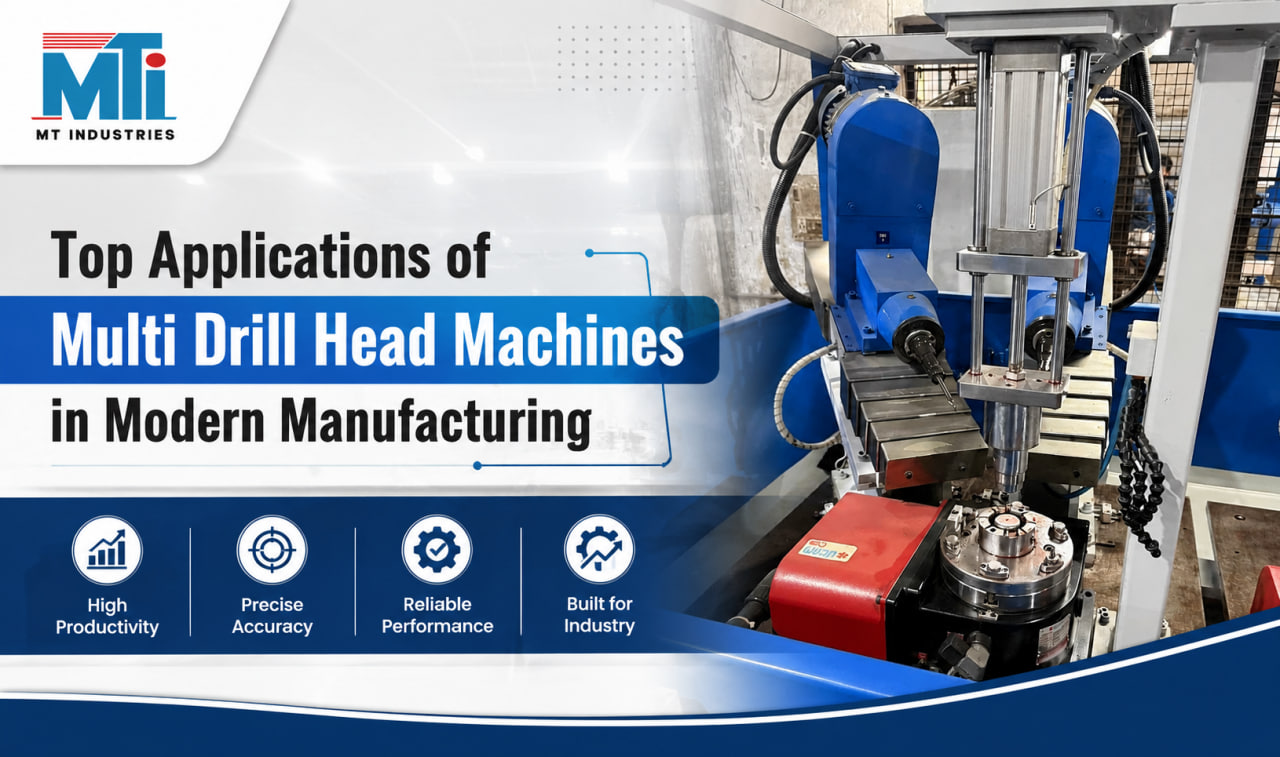
Most manufacturers don't think about drilling as a bottleneck until they measure how much time it actually consumes across a production run. Repositioning a part between single-hole drilling cycles adds up fast, and once volume climbs into the thousands, that lost time becomes the difference between hitting delivery targets and missing them. This is where a Multi Drill Head Machine earns its place on the shop floor, cutting multiple holes in one pass instead of one hole at a time.
This article walks through where these machines actually make a measurable difference in production, the industries relying on them most, and what to consider before adding one to your own line.
A Multi Drill Head Machine carries several spindles arranged in a fixed pattern that matches the exact hole layout on a component. Instead of drilling one hole, moving the part, and drilling the next, the entire hole pattern is cut in a single plunge or a short, indexed cycle. The fixture holds the part in place throughout, which removes repositioning error entirely from the process.
This design sits within the broader category of Special Purpose Machines, equipment built around one specific component or process rather than general-purpose flexibility. Because everything from spindle spacing to feed rate is fixed to a known pattern, the accuracy and speed gains over conventional drilling tend to be substantial rather than marginal.
Automotive parts are where multi-spindle drilling probably sees its heaviest use, simply because of the volumes involved. A single bracket or chassis component might need six, eight, or more holes in a fixed bolt pattern, and that same part could be produced by the tens of thousands over a model's production run.
Common automotive applications include:
For this kind of work, a Multi Drilling Head configuration eliminates the variation that would otherwise creep in from thousands of repeated manual positioning cycles, keeping every bracket interchangeable with the next.
Electrical enclosures, distribution panels, and control boxes almost always require multiple holes for mounting hardware, cable glands, and component fixtures. These parts are typically flat sheet metal, which makes them well suited to fast, single-plunge drilling.
A Multi Drilling Machine set up for panel work commonly handles:
Because panel manufacturers often run several product variants through the same line, the ability to quickly reconfigure or swap tooling on a multi-head setup becomes almost as important as the drilling speed itself.
Valve bodies, manifolds, and cylinder components depend on precise hole positioning for port alignment — a misaligned port doesn't just look wrong, it can restrict flow or cause a seal failure under pressure. This is an area where a Precision Multi Drill Spindle setup matters as much as the multi-head configuration itself.
Typical applications here include:
Spindle rigidity is particularly important in this category because even a small amount of runout across multiple spindles can throw off port alignment enough to affect pressure sealing.
Larger structural components — frame sections, mounting plates, heavy brackets — bring a different challenge: material thickness and hardness. Drilling through thick steel or cast components at multiple points simultaneously requires more than just spindle count; it requires the rigidity and torque capacity found in Industrial Multi Drilling SPM equipment built specifically for heavy-duty work.
This category typically covers:
Under-specifying machine capacity for this kind of work usually shows up quickly as excessive tool wear or inconsistent hole quality, which is why heavier applications generally call for a purpose-built setup rather than a lighter general-purpose machine adapted to the job.
Not every application involves heavy industry. Consumer appliances, furniture hardware, and general sheet-metal fabrication also benefit from multi-spindle drilling wherever a repeated hole pattern shows up across high volumes — think appliance panels, shelving brackets, or hardware fittings produced by the tens of thousands.
In these lighter applications, the priority tends to shift slightly toward changeover speed and tooling flexibility, since product lines often rotate through several similar-but-different parts rather than running one design indefinitely.
Across every application above, one factor consistently determines whether a multi-head setup holds its accuracy over years of use rather than months: spindle build quality. A Precision Multi Drill Spindle assembly with hardened bearings and controlled concentricity will hold tight tolerances far longer than a lower-grade spindle group, even under identical production volume.
Signs of a well-built spindle assembly include:
Skimping on spindle quality tends to show up as a slow, hard-to-diagnose accuracy drift rather than an obvious failure — which is often more costly in the long run than the upfront savings suggested.
At MT Industries, machine configuration starts with the actual application rather than a fixed catalog model. A team at MT Industries typically reviews the component's material, hole pattern, tolerance requirement, and production volume before finalizing spindle count, spacing, and torque rating — because a setup built for thin electrical panels looks very different from one built for structural steel.
This application-first approach at MT Industries generally results in:
Manufacturers who've worked with MT Industries often note that this kind of application-specific engineering is what prevents the common mistake of buying more machine than a light application needs, or too little for a demanding one.
Before selecting a multi-head drilling system, a few practical questions are worth working through:
Material and thickness — Does the application call for standard spindle torque, or does material hardness require a heavier-duty configuration?
Hole pattern complexity — Is the pattern fixed, or does your product line require occasional tooling changeovers?
Tolerance requirements — What level of positional accuracy does the end application actually demand, and does that match the spindle assembly's rated repeatability?
Production volume — Does your run length justify a dedicated multi-head setup, or would flexibility matter more than raw speed?
Matching the machine to the actual application — rather than the other way around — is usually what separates a setup that delivers real productivity gains from one that simply adds capital cost without solving the underlying bottleneck.
The applications for multi-spindle drilling span a much wider range than most people initially assume — from lightweight electrical panels to heavy structural steel, each with different demands on spindle rigidity, torque, and tooling flexibility. What ties them together is a simple principle: fixing the hole pattern into the machine itself removes the variation that manual, single-spindle drilling can never fully eliminate at scale.
For manufacturers evaluating where a dedicated drilling setup would actually pay off, looking at hole pattern repetition, material demands, and tolerance requirements across your own product line is usually the clearest starting point.
1. What industries use Multi Drill Head Machines the most?
Automotive, electrical panel manufacturing, hydraulic and pneumatic component production, heavy equipment fabrication, and general sheet-metal work are the most common users, primarily due to high volumes of repeated hole patterns.
2. How does a Multi Drilling Head reduce production time compared to standard drilling? It drills all the holes in a fixed pattern in a single plunge or short cycle, instead of repositioning the part for each individual hole, which significantly cuts cycle time per component.
3. What makes a Multi Drilling Machine suitable for high-volume production?
Because the fixture and spindle spacing are fixed to a known hole pattern, accuracy stays consistent from the first part to the last, which is essential when producing thousands of identical components.
4. Why does spindle quality matter in a multi-head drilling setup?
A Precision Multi Drill Spindle assembly with minimal runout and controlled concentricity holds tight tolerances longer, preventing the slow accuracy drift that lower-grade spindles are prone to.
5. What kind of components need Industrial Multi Drilling SPM equipment specifically? Heavier applications like structural steel plates, machinery frames, and large flange assemblies require the rigidity and torque capacity built into industrial-grade SPM equipment, rather than lighter general-purpose machines.
6. Does MT Industries design machines for specific applications or only standard configurations?
MT Industries typically configures spindle count, spacing, and torque rating around the specific component and material, rather than offering only fixed, standard setups.
7. Can a multi drill head machine handle different hole patterns for different products? Most multi-head setups are built around one primary pattern for maximum accuracy, though tooling changeovers can accommodate a limited range of related part variants depending on the machine's design.
8. What's the typical accuracy tolerance for a multi-spindle drilling system?
This depends on spindle build quality and fixture rigidity, but well-engineered systems commonly hold positional repeatability within microns across long production runs.
9. How do I know if my production line needs a dedicated multi drilling setup?
If you're running high volumes of components with a fixed, repeated hole pattern, a dedicated multi-head setup usually pays back faster in reduced cycle time than continuing with single-spindle drilling.
10. What maintenance does a multi drill head machine require over time?
Routine maintenance typically includes spindle bearing checks, runout inspection, tool sharpness monitoring, and periodic calibration to prevent gradual positional drift.