

 GET A QUOTE
How to Evaluate a Special Purpose Machine Manufacturer in India Before Buying
20 September, 2026
Powering Industries with Precision Engineering

23 May, 2026
With time, manufacturing businesses have become dynamic and seek to improve their productivity and reduce costs, among other factors. While traditional techniques are proving difficult to keep pace with new demands, modern industries are turning to Special Purpose Machines (SPM machines) as the solution.
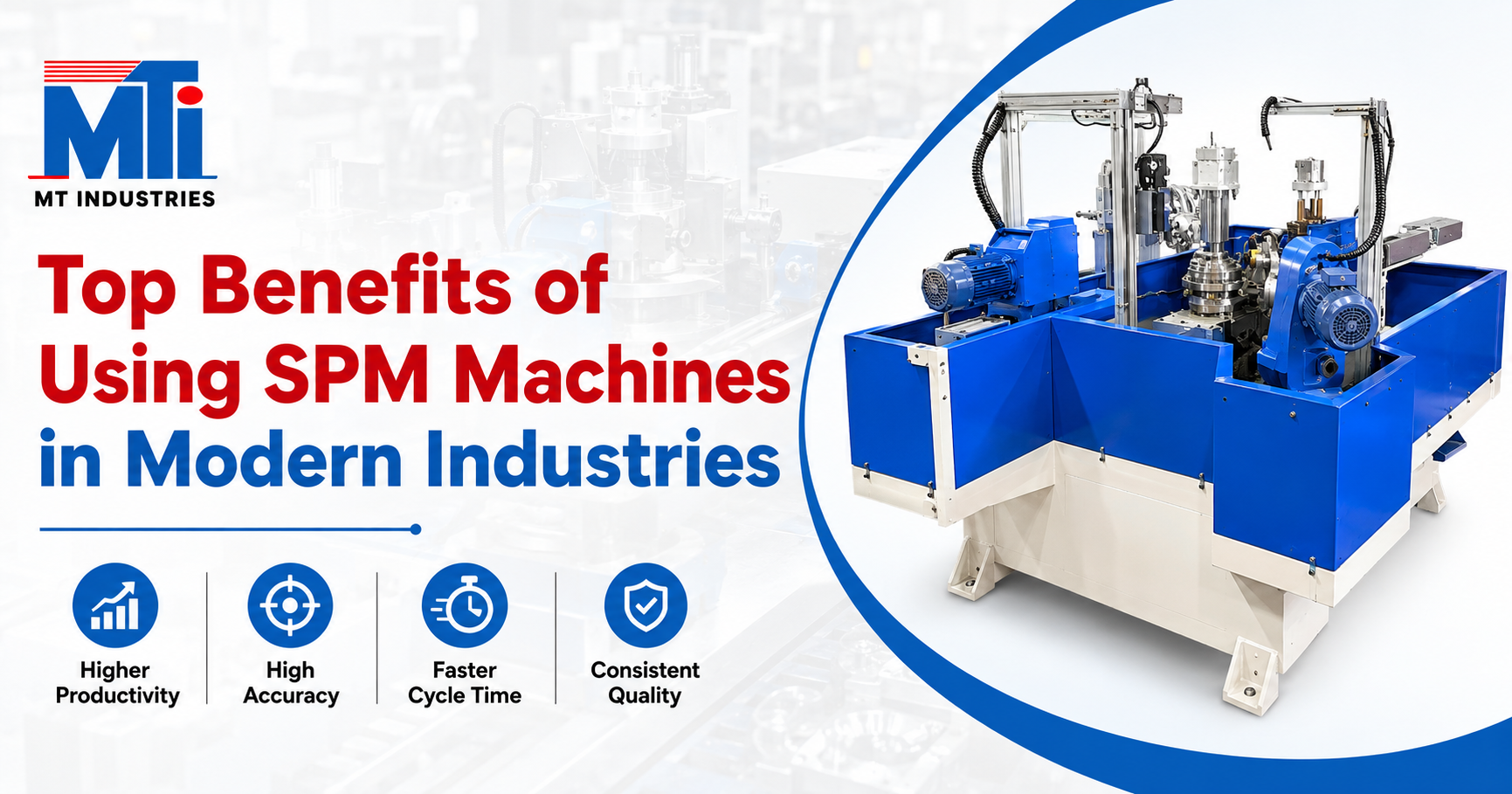
The advantages of SPM Machines in Industries extend to many areas apart from automation. SPM machines are designed to execute repetitive activities with high accuracy, including drilling, tapping, assembly, inspection, welding, and material handling. Therefore, they help businesses to be more efficient through the reduction of reliance on human intervention.
One of the reliable sources of automation equipment and Special Purpose Machines is MT Industries.
Special-purpose machines are specially made machines that are meant for certain manufacturing activities. As opposed to regular machines, special-purpose machines are built specifically to carry out a particular job, with high levels of accuracy and efficiency.
Examples of fields where special-purpose machines are utilised include:
Production Efficiency Improvement
Another significant benefit of using SPMs lies in their capability to execute repetitive activities efficiently and accurately. Companies can improve their production process efficiency through the automation of tasks that would otherwise need manual execution.
For instance, tasks such as automated drilling and tapping will only take a few seconds to be executed, thus increasing production efficiency.
Reduction of Workforce Needs
A major problem facing most manufacturers is the shortage of labour and high manpower costs. In this regard, SPMs assist companies in saving labour costs by executing repetitive activities automatically.
Companies are able to accomplish more work since one operator is capable of managing an entire automated production process. This boosts efficiency while minimising costs.
Improved Product Quality and Consistency
The quality of products produced becomes easy to ensure when activities are automated. Due to the automated nature of SPM machines, human errors become very minimal.
Quality and consistency are particularly important in certain fields like automotive and aeronautical manufacturing, where quality assurance is paramount.
One of the key advantages of special-purpose machines is their faster production. These machines are designed to perform dedicated operations continuously, helping manufacturers complete larger orders in less time.
Faster production also improves delivery timelines and customer satisfaction.
Although SPM machines require an initial investment, they offer long-term savings through reduced labour costs, lower material waste, and improved operational efficiency.
Many industries now prefer cost-effective manufacturing machines because they help improve profitability while maintaining production quality.
Automation reduces direct human involvement in risky operations such as drilling, welding, or heavy material handling. This creates a safer working environment and lowers workplace accident risks.
There is an ever-increasing need for automation. The companies are now opting for automated manufacturing processes in order to stay ahead of their competition.
The modern systems of automation assist the industries in:
The advantages provided by the automation industry are aiding industries in transitioning into intelligent manufacturing systems.
The production rate is highly important in competitive markets because it impacts the bottom line. Organisations that have high-output machinery can manufacture large volumes of goods in relatively shorter periods of time while retaining quality standards.
This proves advantageous for organisations engaged in bulk production operations and tight deadlines.
Modern SPM systems also provide multiple-operation capacity, which enables businesses to undertake different operations in one setting.
Selecting the right automation partner is important for achieving long-term production success. Businesses should look for manufacturers that offer customisation, technical expertise, durable machine design, and reliable after-sales support.
MT Industries specialises in manufacturing advanced SPM machines, multi-drilling machines, multi-tapping machines, and automation systems designed to meet modern industrial requirements.
Their focus on precision engineering and affordable automation solutions helps industries improve operational efficiency while controlling production costs.
Industrial Benefits of SPM Machines in Industry are revolutionising the current manufacturing operations. Whether in terms of increasing production time and decreasing labour requirement or increasing production quality, SPM machines have become an inevitable aspect of industrial automation.
The increased need for modern manufacturing machinery is causing companies to invest in automation solutions for higher levels of productivity.
MT Industries remains a leading provider of efficient automation products and services that can increase the production capabilities of industries through better manufacturing performance and reduced production costs.
Businesses requiring modernisation in their production operations can highly benefit from SPM technologies.