

 GET A QUOTE
How to Evaluate a Special Purpose Machine Manufacturer in India Before Buying
20 September, 2026

Powering Industries with Precision Engineering

24 July, 2026
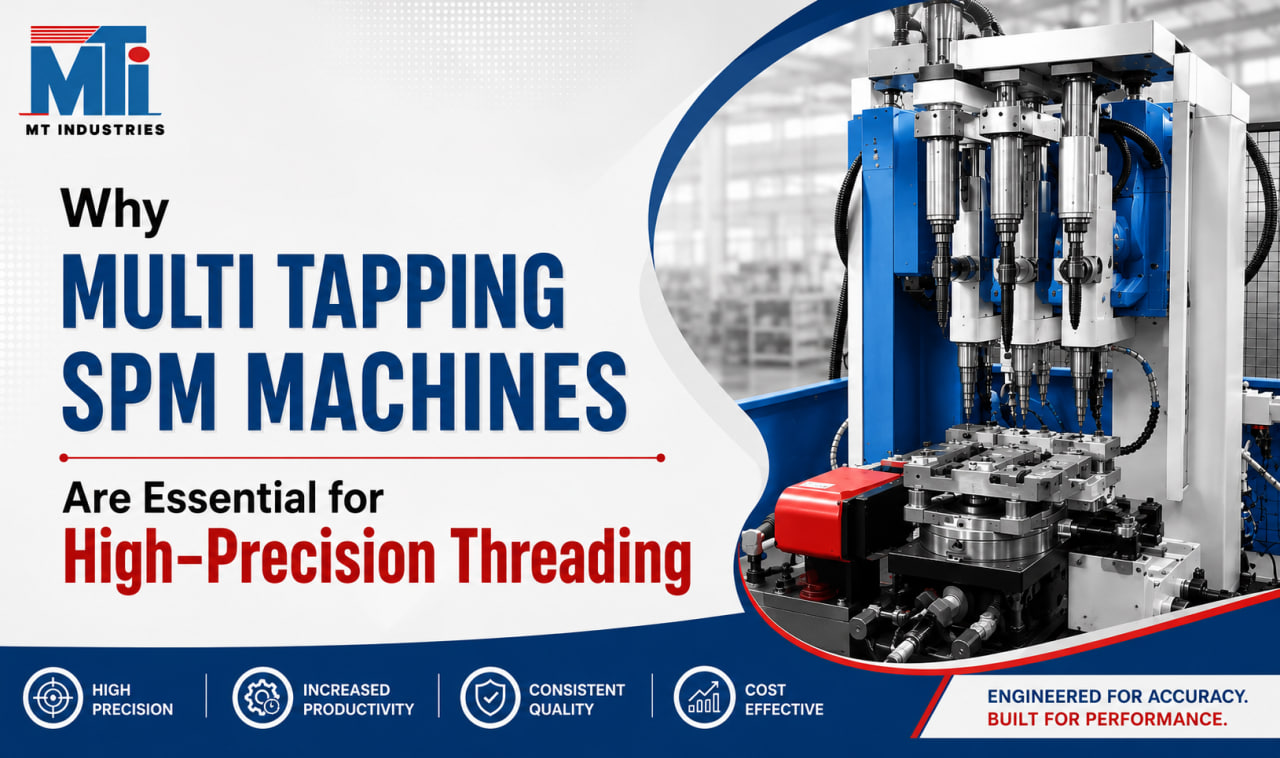
Threading is one of those operations where a small error doesn't just create a bad part — it can compromise an entire assembly. An oversized or misaligned thread might still let a bolt go in, but it won't hold torque the way it's supposed to, and that failure often doesn't show up until the product is already in the field. This is exactly why manufacturers running high volumes of threaded components have largely moved away from manual tapping and toward a Multi Tapping SPM Machine built specifically for the job.
This article breaks down why threading accuracy is so hard to maintain manually, how multi-spindle tapping systems solve that problem, and what to look for before adding one to your production line.
A Multi Tapping SPM Machine is a Special Purpose Machine designed to cut internal threads on multiple points of a component in a single cycle, using a fixed tap-head arrangement matched to the part's hole pattern. Unlike a manual tapping setup where each hole is threaded individually — often with hand-fed pressure and operator judgment on depth — an SPM locks tap position, depth, and rotation speed into a repeatable, mechanically controlled process.
Because tapping is far less forgiving than drilling — thread pitch, depth, and perpendicularity all have to be right simultaneously — this category of machine tends to deliver a bigger accuracy improvement over manual methods than most other machining upgrades.
Before looking at how SPMs solve the threading problem, it's worth understanding where manual tapping actually breaks down as output requirements grow:
None of this reflects a lack of skill on the operator's part. It's simply what happens when a precision-dependent process relies on repeated human judgment at scale.
An Automatic Multi Tapping Machine removes most of the manual variables from the equation by controlling feed rate, spindle speed, and depth mechanically rather than by hand. Once the cycle is set for a given part, every subsequent component gets threaded under identical conditions — same entry angle, same depth, same rotational speed.
This matters in a few concrete ways:
For manufacturers producing threaded components at scale, this shift from manual to automatic tapping is often where the biggest single jump in first-pass yield comes from.
Threading tolerance isn't just about hitting the right pitch — it's about consistency across thousands of cycles. A properly built Precision Tapping Machine is engineered around this requirement from the start, with rigid tap holders, closely controlled spindle alignment, and tap-drill synchronization built into the mechanical design rather than left to operator adjustment.
Well-built precision tapping systems typically deliver:
For industries like automotive, hydraulics, and structural fastening — where a stripped or undersized thread can mean a warranty claim or a safety issue — this level of consistency isn't optional. It's the baseline a customer expects the part to meet.
Not every application involves light-gauge sheet metal or small fasteners. For components made from tougher materials — cast iron, hardened steel, thick structural plate — a standard tapping unit often can't sustain the torque and rigidity needed without excessive tap wear or breakage. This is where a Heavy Duty Tapping Machine becomes necessary rather than optional.
Heavy duty tapping systems are typically built with:
Manufacturers working with heavier materials — structural fabrication, heavy equipment components, industrial valve bodies — generally find that under-specifying machine capacity here leads directly to higher tap breakage rates and inconsistent thread quality.
At the center of most multi-tapping systems is the tap-head assembly itself, known as a Multi Tap Head Machine. Instead of a single tap threading one hole at a time, this configuration holds several taps arranged to match the exact hole pattern on the component, threading multiple points in one synchronized cycle.
This configuration matters for accuracy because it removes the repositioning step between holes entirely — once the tap-head is set and locked to the part's pattern, there's no manual realignment left to introduce error between the first hole and the last.
Common applications include:
At MT Industries, threading accuracy is treated as a design requirement from the very first drawing rather than something adjusted after the machine is built. The engineering process at MT Industries typically starts by reviewing the component's material, thread specification, and tolerance requirement before deciding on tap-head configuration, spindle torque, and cycle control.
This approach at MT Industries generally focuses on three things:
Manufacturers who've worked with MT Industries often point out that the real gain isn't just faster tapping cycles — it's fewer rejected parts and fewer warranty claims tied back to thread quality months down the line.
A few practical questions are worth answering before committing to a machine:
Thread specification — Does the machine's tap-drill synchronization match the exact pitch and thread class your parts require?
Material hardness — Will standard torque handle your material, or does the application call for heavier-duty spindle capacity?
Production volume — Does your run length justify a dedicated multi-tap setup, or would a single-spindle machine still be cost-effective?
Tap maintenance — How easily can worn taps be replaced without extended downtime, and what's the expected tap life for your material?
Depth control method — Confirm whether depth is mechanically fixed or relies on adjustable stops, especially for blind-hole applications.
Working through these details upfront prevents the common mistake of choosing a machine that can't sustain the thread quality your customers actually require.
High-precision threading isn't really about tapping faster — it's about removing every source of variation between the first threaded hole and the last one on a production run. A properly engineered multi-spindle tapping setup does this by locking tap-drill synchronization, feed control, and alignment into a fixed, mechanically repeatable process rather than leaving it to hand feel. Between rigid tap-head design, heavy-duty capability for tougher materials, and growing automation, manufacturers now have a realistic path to consistent thread quality even at volumes that would overwhelm a manual process.
For teams still relying on manual tapping for high-volume threaded parts, moving to a dedicated multi-tapping setup remains one of the most direct ways to cut rejections and protect downstream assembly reliability.