

 GET A QUOTE
Drilling and Tapping SPM Machines for Precision Component Manufacturing
22 September, 2026
Powering Industries with Precision Engineering

21 September, 2026
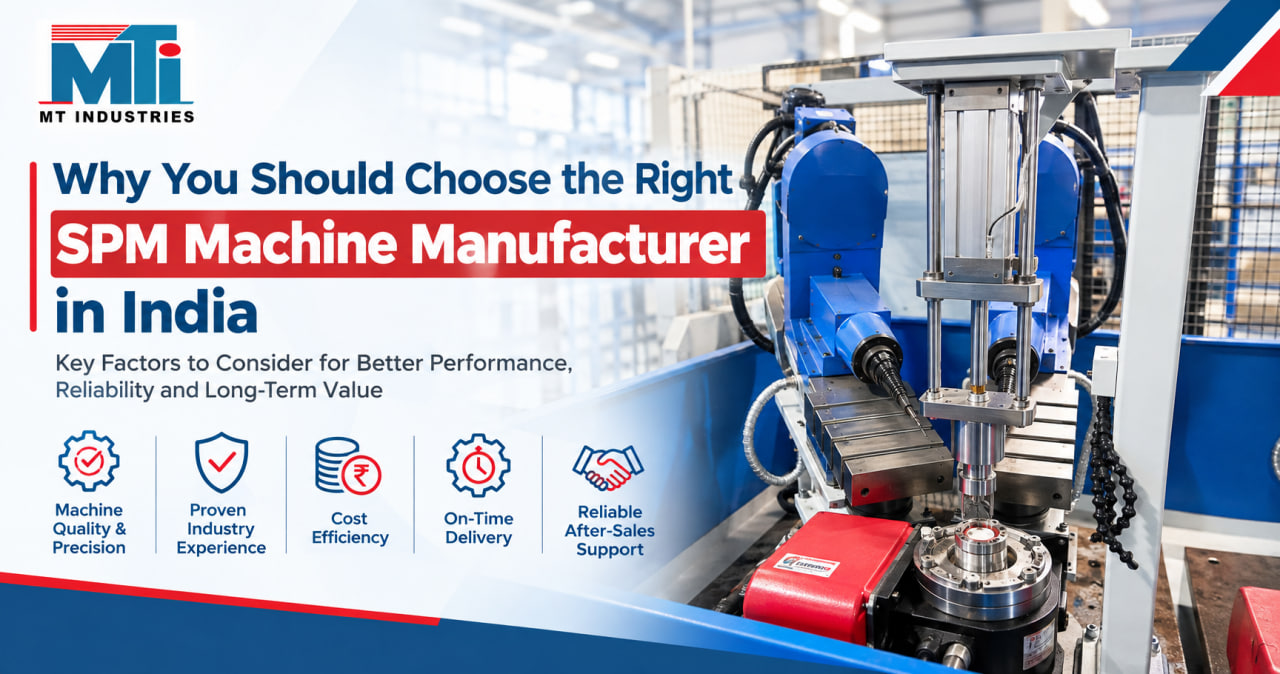
The manufacturer you pick for an Assembly Line Machine ends up shaping your production output long after the paperwork is signed. Get it right and your line hums along with barely any hiccups. Get it wrong and you're firefighting constant breakdowns, chasing support that never quite shows up, and working around equipment that was never really built for your process to begin with. Every manufacturer across India will tell you they're the best fit, so how do you actually separate the genuine ones from the rest?
Glossy presentations are easy to produce. Real engineering capability is not. What you want to know is how long the company has actually been designing and building equipment, which industries they've worked in, and whether they've built anything close to what your line needs. A team with decades of genuine shop floor problem-solving picks up on details that a newer or purely sales-driven outfit simply hasn't run into yet.
Questions worth putting to them directly:
Ordinary equipment rarely slots into a production line without some kind of trade-off. Sooner or later, most serious operations need a machine built around their own tolerances, cycle times, and product quirks. That's exactly the gap a Custom Assembly SPM fills, since it starts from a blank sheet rather than being tweaked from an existing model.
A manufacturer worth your time should walk you through their custom build process without hesitation, including how prototyping, testing, and revisions happen before anything ships. If all they offer is a handful of fixed configurations with no room to adapt, that's usually a sign their engineering bench isn't as deep as it should be.
An Industrial Assembly Machine that keeps breaking down will cost you more in lost hours than it ever saved you on the invoice. Reliability isn't something to check off at the end of the conversation; it should be near the top of it.
Points worth pressing on:
A manufacturer confident in their build will talk through all of this without steering you back to a spec sheet every time.
Installation day is the beginning of the relationship, not the finish line. Ask what support looks like once the equipment is actually working on your floor. Will operators get trained properly? What's the plan if something critical fails mid-shift? Can issues be diagnosed remotely, or does every problem mean waiting for someone to physically show up?
Manufacturers who actually think long-term usually have a defined support structure ready to describe, not just reassurances offered in the sales meeting.
The cheapest bid rarely turns out to be the smartest one once you look at the machine's entire working life. Build quality, ongoing maintenance, downtime risk, and the manufacturer's actual track record all belong in that calculation before price gets the final say. Paying a bit more upfront for a properly engineered machine tends to pay itself back many times over through fewer breakdowns and a longer service life.
MT Industries has spent over 40 years building assembly and SPM solutions for names like Uno Minda, Havells, and Crompton. That kind of hands-on history means we know what actually matters once a machine hits the shop floor, not just what sounds good in a proposal. Whether you're looking for something standard or a fully Custom Assembly SPM built around your exact process, working with a manufacturer who has genuine engineering depth makes a real difference to what your line can output.
Q1. What should weigh heaviest when picking an assembly machine manufacturer?
Engineering experience and a proven reliability record usually matter far more than the upfront price tag, since those two things drive long-term production efficiency.
Q2. How long does a custom assembly SPM typically take to build?
It varies with complexity, but most custom builds run several weeks from finalising the design through to commissioning.
Q3. Do reputable manufacturers offer support after the sale?
Yes. Most established manufacturers provide operator training, spare parts access, and ongoing maintenance once the machine is up and running.
Q4. Can one manufacturer handle both standard and custom assembly machines?
Plenty of experienced manufacturers do both, letting companies start with standard equipment and move toward custom builds as their requirements grow.
Q5. Why does in-house engineering matter when choosing a manufacturer?
In-house design teams generally deliver tighter quality control and faster fixes compared to manufacturers who farm out their core engineering work.