

 GET A QUOTE
How to Choose a Drilling Machine Manufacturer in India for Automated Production
9 October, 2026
Powering Industries with Precision Engineering

4 August, 2026
Step onto any serious manufacturing floor and you'll notice something fairly quickly. The machines carrying the real workload, running shift after shift without a hitch, aren't usually the flashiest pieces of equipment in the room. They're just built right for the job at hand. And when it comes to drilling multiple holes with precision, speed, and consistency, picking the correct machine isn't something you want to get wrong.
So how do you actually land on the right one? Let's work through it.
Start With Your Production Volume
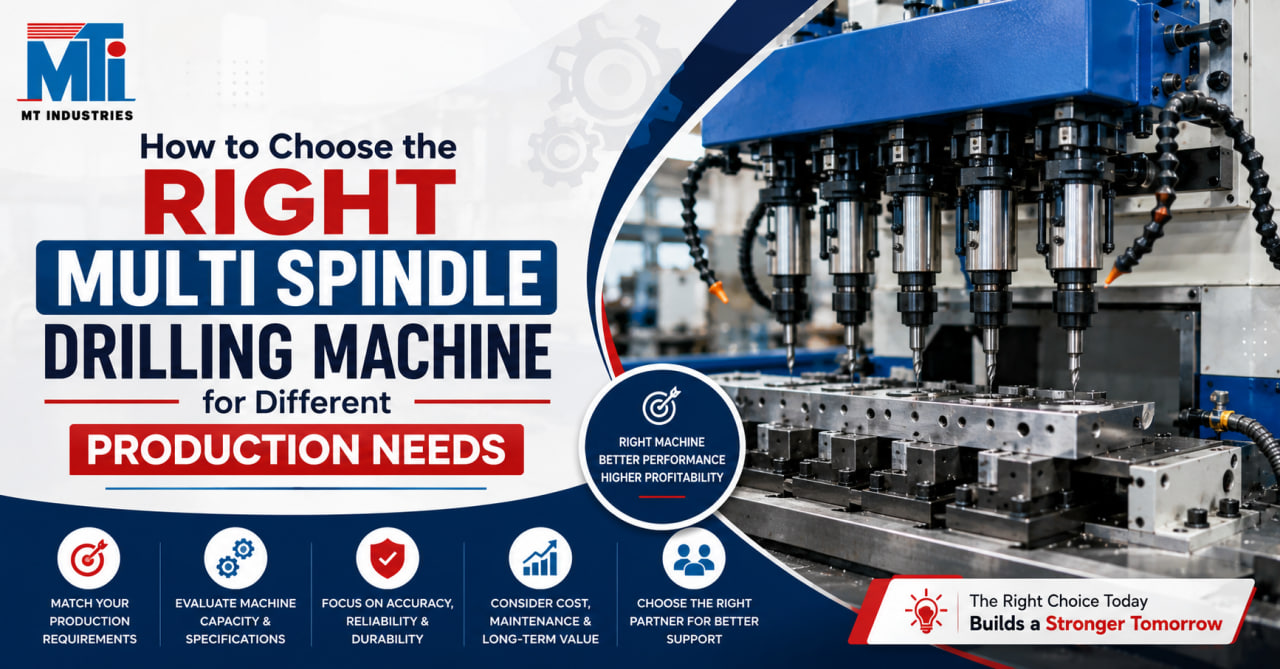
This is where most buyers ought to begin, honestly. Are you handling a small batch job or churning out thousands of identical components every single day? A Multi Spindle Drilling Machine is built specifically for high volume operations where several holes need drilling simultaneously, cutting cycle time significantly compared to single-spindle setups.
If your production numbers stay modest, you might not need the full capability these machines bring. But if you're scaling up or already juggling tight delivery timelines, this is exactly the kind of equipment that pays for itself quickly.
Think About Hole Pattern Complexity
Not every job calls for the same spindle configuration. Some components need holes arranged in simple straight lines. Others require complex, staggered patterns across multiple planes. Before finalising anything, map out your part's drilling requirements in detail.
Ask yourself these questions:
Getting clarity here saves headaches down the road. Nobody wants to invest in machinery only to find out it can't handle a design change six months later.
Precision Requirements Matter More Than You Think
Here's something buyers often underestimate. Not every drilling machine offers the same level of precision, and in some industries a fraction of a millimetre off means a rejected part. Loose tolerances just won't do in automotive components, aerospace fittings, and precision engineering applications.
This is where the Precision Multi Drilling Machine lives up to its name. These machines are built to much tighter tolerances, better spindle alignment and a more rugged design to maintain accuracy over long production runs. If your parts feed into assemblies where fit and function aren't negotiable, don't cut corners here. Precision isn't optional; it's the entire point.
Material Compatibility Is Non-Negotiable
Steel, aluminium, cast iron, brass. Every material behaves differently under a drill bit. Some generate more heat, some are prone to burring, and some need slower spindle speeds to avoid excess tool wear. A machine that performs beautifully with mild steel might struggle badly with hardened alloys.
Talk to your equipment supplier about which materials you'll be running most often. A properly configured Multi Spindle Drilling SPM can be built around your specific material requirements, right down to spindle speed ranges, coolant systems, and tooling selection. This isn't a common decision, and treating it like one usually backfires down the line.
Don't Ignore Automation and Changeover Time
Production floors running multiple product lines need equipment that adapts fast. How long does it take to switch tooling between jobs? Can the machine handle automated loading and unloading? These questions carry just as much weight as raw drilling capability.
A machine that drills beautifully but takes three hours to reconfigure for the next job will eat into your daily output fast. Look for designs that prioritise quick changeovers alongside strong drilling performance, especially when your production schedule shifts often between part numbers.
Factor in Long-Term Reliability
Cheap machinery that breaks down every few weeks isn't actually cheap. It's expensive in disguise, costing you downtime, repairs, and missed deadlines. Before committing to any supplier, dig into build quality, spindle durability, and after-sales support. A machine built to last will always outperform one built around a lower price point over its lifetime.
Making the Final Decision
Choosing the right drilling setup really comes down to matching the machine's capability to your actual production reality, not just what looks impressive on a spec sheet. Volume, precision needs, material type, and changeover speed should all factor into the decision together, not separately.
MT Industries has spent over four decades building SPM solutions for manufacturers across varying production scales, and that experience comes through in how each machine gets configured. Rather than pushing generic setups, the team works directly with clients to understand their exact drilling requirements before recommending a configuration. For manufacturers weighing their options, that kind of tailored approach often makes the difference between equipment that just works and equipment that actually improves your production line over time.