

 GET A QUOTE
How to Compare Special Purpose Machine Manufacturers in India
21 September, 2026
Powering Industries with Precision Engineering

2 June, 2026
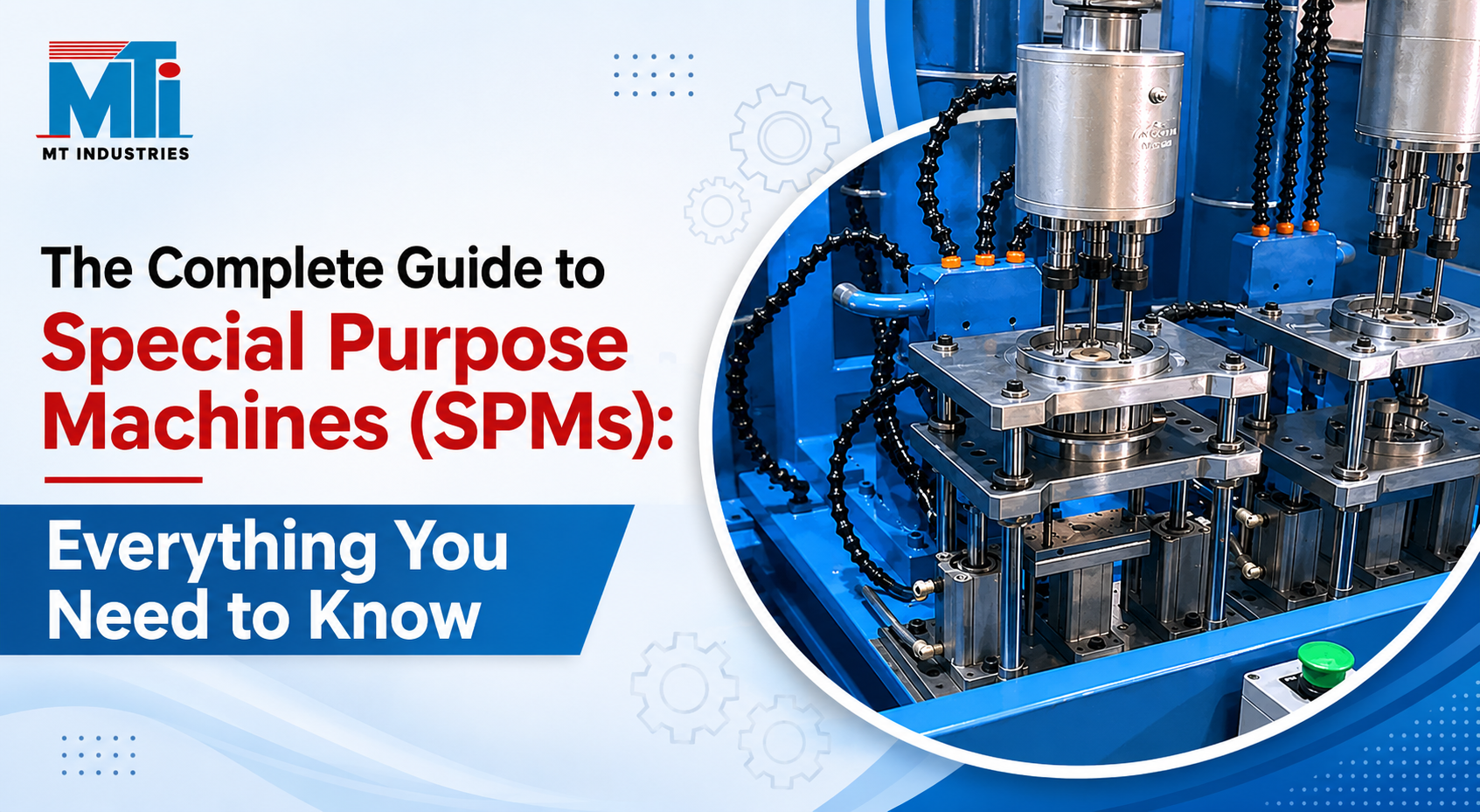
In the present day, many manufacturers are trying to become more efficient by improving productivity rates, decreasing mistakes, and increasing their overall production rate with faster production processes. The Special Purpose Machines that are manufactured as an alternative to traditional or standard types of machines have an essential part within most of these manufacturers' areas of operation. Unlike the standard types of machines, which can perform many different types of operations, SPMs are specially created for one particular type of operation.
SPMs have helped many different types of industry (automotive, engineering, heavy manufacturing, and precision components) achieve higher performance levels and lower production costs through the use of SPM technology. SPMs will help improve the manufacturing process of SPMs, such as drilling, tapping, assembly, cutting, inspecting, or performing multiple operations on a single setup.
Custom machinery, known as Special Purpose Machines (SPM), is constructed for specific production activities. They are also manufactured for one or more manufacturing methods (automated or semi-automatic), as required for particular production requirements.
Unlike standard machines that can be used for a variety of products, SPMs promote repeatability and accuracy in a specific production method. Through their ability to produce parts quickly and with minimum manual labour, SPMs improve consistency and decrease total cycle time.
As an example, if an automotive manufacturer has multiple components that each require drilling and tapping, they could use two separate machines to complete both tasks; however, by utilising SPM, they would be able to perform the same procedures on one SPM.
Main Characteristics of SPMs
(i)High production levels of efficiency
(ii) A machine designed to meet the needs of industry
(iii) Precision and accuracy to produce products
(iv) Short production cycle times
(v) Less need for manual labour
(vi) Multi-function capability
(vii) Greater consistency of product
These characteristics make SPMs ideal for mass-producing industries.
Every machine is created based on the desired production and design. Special-purpose machines are usually designed to automate repetitive industrial processes.
Most Special Purpose Machines work in a standard manner, as outlined below:
Step 1 - Loading Material
The raw workpiece (or operating part) will be loaded into the machine fixture manually (or automatically).
Step 2 - Performing the Automated Operating Function
The SPM will perform the specific operations required, such as, among others, drilling, tapping, milling, assembly, cutting, pressing, or inspecting.
Step 3 - Precision Engineering in the Production Process
Through the manufacturing process, the SPM will maintain the same dimensions and the same level of accuracy with all of the pieces produced.
Step 4 - Output of the Final Product
Once all necessary operations are complete, the finished component is then removed from the machine for use in its next phase of manufacturing.
Modern Industrial Automation Machines often include advanced systems such as hydraulic, pneumatic, servo-controlled, or PLC-based automation for smooth operation and better productivity.
Different industries require different manufacturing solutions, so several different kinds of special-purpose machinery can be used based on specific manufacturing needs.
Multi-drilling machines are used to drill multiple holes simultaneously; this reduces cycle times and increases productivity.
Multi-tapping machines are specifically designed for performing tapping operations simultaneously with very high precision.
Assembly machines are specifically used to automate the industrial assembly process, leading to a more consistent assembly process while removing human error.
Multi-operation machines are designed to perform several operations in a single setup, including drilling, tapping, reaming and finishing.
Many companies require customised manufacturing solutions; these Custom SPM machines are built to the specifications of the product being manufactured and the operational requirements associated with that product.
The increasing trend toward automation has led to many industries adopting special-purpose machines due to the many benefits they provide; let's look at the top three reasons.
A major benefit of using special-purpose machines (SPMs) in manufacturing is their increased production speed. SPMs produce individual products through dedicated machines, thus dramatically reducing the time needed to manufacture parts or assemblies.
When an industry is engaged in mass production, it is clear that a reduced cycle time also improves the amount of product produced in a given amount of time.
When manufacturing products, accuracy and precision are important; they are especially important in industries, such as automotive and engineering, that require components to fit together perfectly and comply with stringent quality standards. Precision operations are delivered by SPMs, resulting in fewer product defects caused by incorrectly manufactured components, thereby assuring manufacturers maintain an acceptable level of quality.
This is where Precision Engineering Solutions comes into play to make sure that manufacturers produce products with consistent quality.
Due to the fact that many of the manufacturing processes are performed manually, there is a significant potential for human error. The addition of Industrial Automation Machines minimises the reliance on manual labour, therefore reducing the likelihood of an error occurring while completing a manufacturing operation.
Although the initial investment in Special Purpose Machinery may seem high, businesses save money over time through:
Consistency is critical in industrial production. SPMs ensure every component is manufactured with the same level of quality and precision.
In today's world, Special Purpose Machines (SPM) are common in several sectors.
The automotive industry is highly dependent on SPM for drilling, tapping, and assembling automobile parts as well as making parts for automobiles.
Precision engineering companies depend on SPM for the manufacture of accurately built mechanical parts; therefore, they use SPM to increase production capabilities and accuracy.
SPM plays a key role in assembling and manufacturing electrical products by providing accurate, precision parts to the supplier of electrical products.
The aerospace industry uses highly specialised SPMs to manufacture extremely accurate aircraft and helicopter parts and components.
Many different manufacturers utilise Automated Production Machines for the purposes of packaging, assembling and processing their consumer products.
Competition in manufacturing is increasing every year, which means that businesses must produce faster, make fewer mistakes and work better than their competitors.
Therefore, one of the main reasons why companies have started investing in industrial automation machinery and custom-built special-purpose machines is that it enables them to gain an advantage over their competition by becoming more efficient.
The benefits of using automation include:
(i)Productivity improvements
Machines can run continuously with very little downtime.
(ii) Improving product quality
Manufacturing using precision machinery reduces defects.
(iii) Operational cost reductions
Automation reduces the amount of labour required and reduces the waste associated with manufacturing.
(iv) Meeting high demand from customers
Companies can produce products more quickly to meet their customers' needs.
Selecting the right SPM Machine Manufacturer is crucial to the business's success over a long period of time. To assist businesses in their decision, we have broken down some factors to think about before making their investment.
Find a manufacturer that offers extensive experience in the industrial and technical aspects of automation systems.
Each industry has different manufacturing demands; therefore, a good manufacturer would be able to offer Custom SPM machines to meet these needs.
The quality of the machines directly correlates to production and durability; therefore, ensure you check what manufacturing standards the company uses.
It is important that the supplier has After-Sales Services and Technical Support to ensure there are no problems with the operation of their equipment.
Before choosing a manufacturer, ensure you have reviewed their documented experience with previous projects and any other experience in that industry.
MT Industries has been providing top-notch SPMs for more than 40 years. We provide Advanced Special Purpose Machines, Industrial Automation Systems, Multi-Drilling and Multi-Tapping Machines, and Customised Precision-engineered Solutions for High Performance Manufacturing.
The future for advanced special-purpose machines appears bright as more manufacturers create automated, high-tech production facilities around the world.
More manufacturers are integrating additional features into their special-purpose machines through the adoption of the fourth industrial revolution:
• smart sensors
• PLC automation
• monitoring using IoT
• robots
• AI systems used in manufacturing systems
Over the next few years, Automated Production Machines will be able to produce products much more quickly and with greater precision than before.
Special Purpose Machines (SPMs) have transformed modern manufacturing by improving speed, precision, and operational efficiency. Whether it is drilling, tapping, assembly, or custom industrial automation, these machines help businesses achieve consistent quality and higher productivity.
As industries continue moving toward automation, investing in the right Special Purpose Machinery can help manufacturers stay competitive and meet growing market demands.
If you are looking for reliable and high-performance Special Purpose Machines, partnering with an experienced manufacturer like MT Industries can help you get customised solutions designed specifically for your production requirements.
1. What are SPM?
SPMs are machines in industry designed specifically for a certain task, e.g. to drill, tap and/or assemble, etc. or machines that do many different processes at one time.
2. What are the benefits of SPM?
SPM increase: Production speed; production accuracy; production consistency; production efficiency; and decrease: Labour costs; human error in production
3. What industries use SPM?
Examples of SPM industries include: Automotive, Engineering, Aeronautics, Electrical, Computer/Manufacturing.
4. How are SPMs different from conventional machines?
Conventional machines perform multiple general manufacturing processes, whereas SPM perform one specific manufacturing process, which results in SPM having a greater manufacturing efficiency.
5. Why should I invest in SPM?
SPM manufacturers invest in SPM to increase productivity, reduce manufacturing costs, and produce better quality products.