

 GET A QUOTE
How to Evaluate a Special Purpose Machine Manufacturer in India Before Buying
20 September, 2026
Powering Industries with Precision Engineering

24 July, 2026
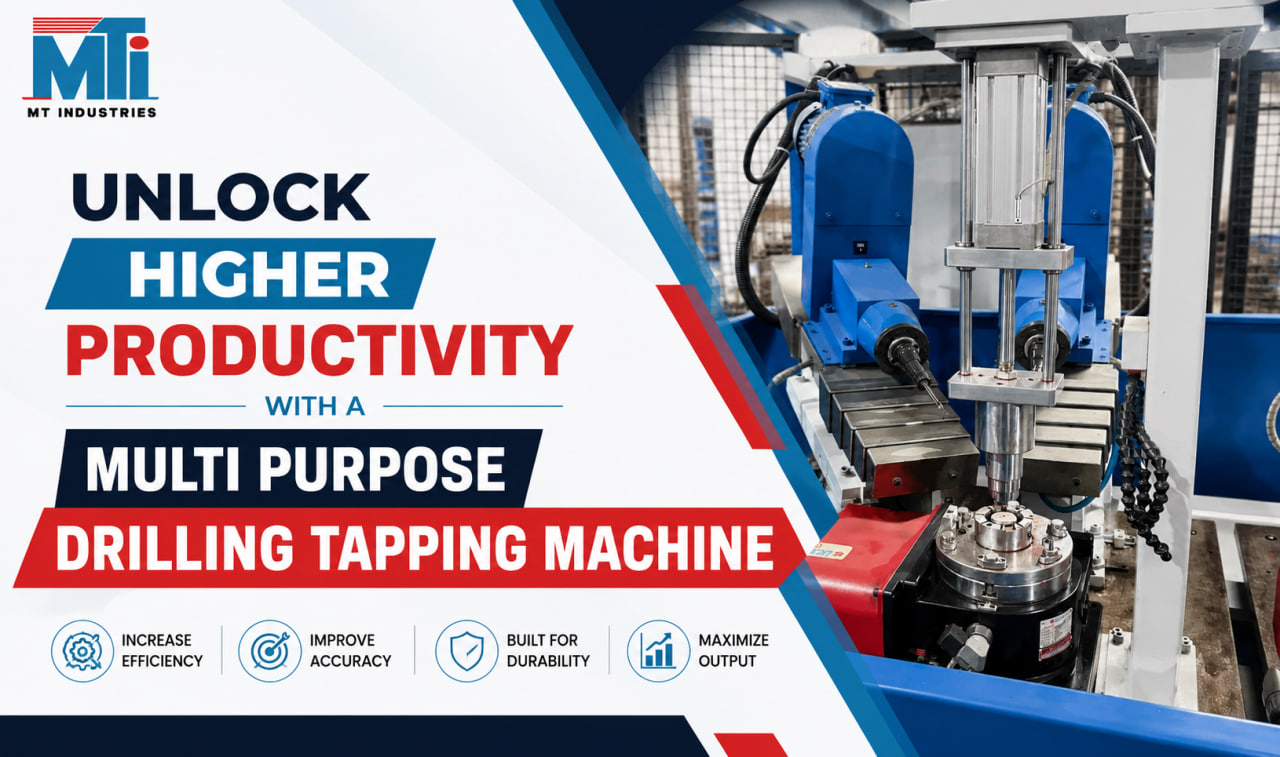
Manufacturing units are under constant pressure to cut cycle times, reduce rejections, and produce more without adding machines or manpower. This is exactly the problem a Multi Purpose Drilling Tapping Machine was built to solve. Instead of running drilling, tapping, and remaining as three separate operations on three separate machines, a single, well-engineered platform can now handle all of it, saving time, floor space, and labor cost in the process.
This article looks at what such a machine actually does, why combining operations changes shop-floor efficiency, and what to check before you invest in one.
At its core, this is a machine tool built to perform more than one metal-cutting operation drilling, tapping, counterboring, and sometimes remaining within a single setup. A standard drill press only makes holes. This type of machine goes further: it integrates extra spindle heads and tooling stations so a part can move through several operations without ever being unclamped or shifted to another station.
Machines built this way fall under what the industry generally calls Special Purpose Machines, or SPM equipment configured for a specific job or component rather than general-purpose use. Because they're designed around one defined process, they tend to deliver noticeably better repeatability and speed than universal machines.
In a conventional setup, a part often travels between three or four machines: one station drills, another taps, maybe a third handles chamfering. Every handoff between stations adds:
Bringing these steps together into one setup removes most of that overhead. Once a component is clamped into its fixture, several spindles can drill and tap in one continuous or indexed cycle. Manufacturers who move from a conventional multi-machine layout to this kind of consolidated setup commonly report cycle-time improvements of 30–50%.
A key part of most multi-purpose setups is the spindle head itself often referred to as a Multi Drill Head Machine. Rather than one spindle drilling a single hole at a time, this configuration carries several spindles arranged to match the exact hole pattern on the part. A plate needing eight holes, for instance, can have all of them drilled in a single plunge instead of eight separate passes.
This approach works particularly well for components such as:
Cutting down cycle time per part translates directly into higher daily output, without needing more labor or additional floor space.
Speed alone doesn't help if accuracy drifts across a production run. This is where a properly built Precision SPM Machine earns its keep. These units rely on rigid fixtures, hardened tooling, and closely toleranced spindle assemblies so that hole diameters, thread depths, and hole positions stay consistent from the first part to the ten-thousandth.
A well-built precision setup typically delivers:
For sectors like automotive, defense, and hydraulics, where one misaligned hole can compromise an entire assembly this level of consistency isn't a nice-to-have. It's the baseline expectation.
General-purpose machine tools are designed for flexibility across many jobs. Industrial SPM Equipment, by contrast, is designed around one specific production requirement. That distinction changes how the machine is built from the start, fixtures, spindle spacing, tooling, and even the control panel are matched to the exact part being produced.
The practical advantages of this approach include:
Companies producing components at scale automotive parts, electrical fittings, industrial valves often find that a dedicated setup pays for itself within months simply through reduced cycle time and scrap.
As labor costs climb and quality expectations tighten further, many manufacturers are shifting toward Automated SPM Solutions. This doesn't necessarily mean full robotics; it can be as simple as programmable spindle sequencing, automatic tool changes, or PLC-based cycle control that takes manual judgment out of repetitive steps.
The benefits typically include:
For manufacturers scaling up, this kind of automation is quickly becoming a standard client expectation rather than an optional upgrade.
At MT Industries, the design process starts with the actual component and its production volume not a catalog machine adapted to fit. That's really the difference between a generic drilling unit and a purpose-built machine that solves a specific manufacturing problem.
Broadly, the engineering approach at MT Industries covers three things:
Manufacturers who've worked with MT Industries often point out that having the machine built around their part instead of adapting their process to fit a standard machine is what actually delivers the productivity gains they were after.
A few practical questions are worth answering before committing to a purchase:
Component compatibility Does the fixture and spindle layout actually match your part's hole pattern and material?
Production volume High-volume, repetitive runs justify a dedicated setup; low-volume or highly varied jobs may still be better served by a general-purpose machine.
Tolerance requirements Does the machine's repeatability meet your quality standards, particularly for tapped threads?
Maintenance and support Spindle bearings and tooling wear over time. What does the supplier offer in terms of servicing and spare parts?
Scalability Can the machine be reconfigured or expanded if your production needs grow later?
Working through these points before purchase helps avoid a mismatch between what the machine can do and what your shop floor actually needs.
A well-designed multi-purpose drilling and tapping setup isn't just about combining a few operations into one; it's about rethinking how a part moves through your process from start to finish. Between faster spindle configurations, tighter precision, purpose-built equipment, and growing automation, the goal stays the same: more accurate parts, produced faster, with fewer resources spent getting there.
For manufacturers still running separate drilling and tapping stations, moving to an integrated setup remains one of the more direct ways to lift both output and consistency at the same time.
A standard drilling machine only makes holes. A multi-purpose version can drill, tap, and often ream or counterbore in a single setup, which cuts handling time and improves accuracy.
It drills several holes at once through spindles arranged in the required pattern, instead of drilling one hole at a time which significantly reduces cycle time per part.
Automotive, hydraulics, electrical, defense, and general engineering sectors rely on them wherever tight tolerances and repeatable hole accuracy are non-negotiable.
It's most cost-effective for medium-to-high volume runs. Small-batch or highly varied jobs are often still better handled on general-purpose machines.
SPM stands for Special Purpose Machine equipment built for a specific component or process rather than general, flexible use.
Yes. Most modern automated SPMs use PLC controls that can sync with conveyors, robotic arms, and existing quality-check stations.
Replacing two or three separate machines with one integrated unit commonly frees up 40–60% of floor space, depending on the existing layout.
Yes, MT Industries builds machines around the specific component, hole pattern, and production volume rather than offering only fixed, standard configurations.
Routine care includes spindle bearing checks, tool sharpness inspection, lubrication upkeep, and periodic calibration to hold positional accuracy over time.
If you're running high-volume, repetitive drilling and tapping on the same component design, a dedicated setup usually pays back faster than sticking with a general-purpose machine.